
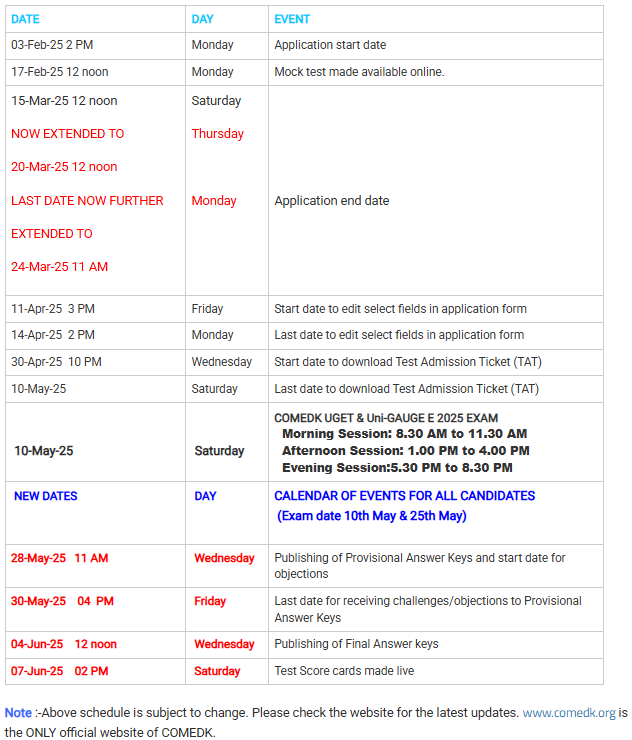
The COMEDK UGET 2025 final answer key has been released on June 4, 2025 at 12 Noon. Candidates can download the key on the official website comedk.org to determine their expected scores and assess their performance. Earlier, the provisional answer key was released on May 28, 2025 at 11 AM and candidates could raise objections till May 30, 2025 (4:00 PM)
- COMEDK UGET Result is declared based on the final Answer key.
For COMEDK UGET 2025, the cut-off ranks for top engineering colleges such as RVCE, BMSCE, and MSRIT will range between 200–550 for popular branches such as CSE and ECE, and less popular branches can expect up to 10,000 cut-offs.
Examination was conducted on May 10, 2025 in three sessions. It was conducted in a CBT Mode in 400 centers all over India for admission into 190 private engineering colleges in Karnataka. However, the Re-Scheduled Exam for certain centres was held on May 25, 2025 in a single shift from 2:00 P.M. till 5:00 P.M. in a CBT Mode. COMEDK has announced the rescheduled dates for COMEDK UGET 2025 and Uni-GAUGE E 2025 exams for specific centers.
- candidates assigned to the following exam centres – Jammu, Srinagar, Amritsar, Bathinda, Jalandhar, Ludhiana, Mohali, Patiala, Bikaner, Jodhpur, Sriganganagar,Jamnagar and Ambala and
- candidates assigned Shift 3 (5.30PM- 8.30PM) in New Delhi, Dehradun, Halwani, Roorkee, Ajmer, Alwar, Bhilwara, Jaipur, Kota, Sikar, and Udaipur.
COMEDK UGET 2O25 Exam Dates
COMEDK UGET 2025 exam dates have been officially announced by the Consortium.
COMEDK UGET 2025 Admit Card
The COMEDK UGET 2025 Admit Card, which is officially known as the Test Admission Ticket, is available on April 30, 2025, on the official website of COMEDK (comedk.org). Do not use mobile phone, use only laptop or desktop.
Candidates should download and bring the admit card to the test center since entry with it will not be allowed.
COMEDK Admit Card Sample
| Particulars Details | ||
| Release Date | April 30, 2025 | Postponed Exam – May 25, 2025 |
| Mode of Availability | Online only (no postal delivery) | |
| Login Credentials Needed | User ID and Password | |
| Details Mentioned |
- Candidate’s Name
- Roll Number
- Photo
- Exam Date & Time
- Center Address
- Exam Instructions
| Mandatory Documents |
- Printed Admit Card
- Valid Photo ID Proof
| Discrepancy Correction | Contact the COMEDK helpdesk immediately |
What is the use of COMEDK?
COMEDK UGET is used for admission to engineering, architecture, and medical courses at more than 150 private colleges in Karnataka.
It provides a gateway for students from all over India to secure seats in top private institutions such as RV College of Engineering, BMS College of Engineering, among others, without having to possess a Karnataka domicile.
COMEDK UGET 2025 Eligibility Criteria
To be eligible for COMEDK UGET 2025, candidates need to fulfil certain eligibility criteria in terms of educational qualifications, marks, and combinations of subjects.
| Criteria Details | |
| Academic Qualification | Passed 10+2 from a recognized board |
| Mandatory Subjects |
- Physics
- Chemistry
- Mathematics
| Minimum Marks | 45% aggregate in PCM(40% for SC/ST/OBC candidates of Karnataka) |
| Diploma Holders | They are not eligible for COMEDK UGET 2025 |
| Age Limit | No minimum or maximum age limit is their |
| Additional Note | English must be one of the studied subjects in 10+2 |
Is COMEDK private or government?
COMEDK is a private group and not a governmental institution.
It is done by the Consortium of Medical, Engineering, and Dental Colleges of Karnataka to regulate admissions in private, independent engineering colleges in Karnataka.
COMEDK UGET 2025 Section Wise Weightage
COMEDK UGET 2025 question paper includes Physics, Chemistry, and Mathematics based on the Class 11 and 12 NCERT syllabus.
Physics COMEDK UGET 2025 Chapter-Wise Weightage
| Chapters Approximate Weightage (%) | |
| Heat and Thermodynamics | 8–10% |
| Electrostatics | 8–10% |
| Current Electricity | 7–8% |
| Optics | 7–8% |
| Laws of Motion | 6–7% |
| Work, Energy, and Power | 6–7% |
Chemistry COMEDK UGET 2025 Chapter-Wise Weightage
| Chapters Approximate Weightage (%) | |
| Chemical Bonding and Molecular Structure | 8–10% |
| Chemical Thermodynamics | 7–8% |
| Coordination Compounds | 7–8% |
| Organic Chemistry (General) | 10–12% |
| Equilibrium | 6–7% |
| p-Block Elements | 6–7% |
Mathematics COMEDK UGET 2025 Chapter-Wise Weightage
| Chapters Approximate Weightage (%) | |
| Coordinate Geometry | 10–12% |
| Calculus (Differential + Integral) | 15–18% |
| Probability and Statistics | 6–8% |
| Matrices and Determinants | 6–7% |
| Three Dimensional Geometry | 6–7% |
| Vector Algebra | 5–6% |
COMEDK UGET 2025 Difficulty level
The level of difficulty for COMEDK UGET 2025 is expected to be moderate, according to the exam pattern of previous years.
The exam focuses on concept clarity, elementary applications, and speed-focused problem-solving.
- Physics: More than 60% of questions would be directly formula-based, and 40% are expected of concept linking.
- Chemistry: More than 70% of questions are expected to be theory-based and the highest weightage is given to Inorganic chemistry.
- Mathematics: 65% questions involved multi-step calculation questions; Algebra and Coordinate Geometry were most dominant.
COMEDK UGET 2025: Subject-Wise Difficulty Analysis
| Subject Difficulty Level (2024 Trend)Nature of Questions Time-Consuming Topics | |||
| Physics | Moderate | Conceptual, formula-based numericals | Mechanics, Electrodynamics |
| Chemistry | Easy to Moderate | Mostly theoretical, direct concept checks | Organic Chemistry |
| Mathematics | Moderate | Application-based, requires calculations | Algebra, Coordinate Geometry |
COMEDK UGET 2025 Marks Vs Rank
The COMEDK UGET 2025 Marks vs Ranks gives candidates an idea of their expected rank based on their exam score.
As the scoring pattern of COMEDK is consistent, a small difference in marks can make a large difference in ranks, particularly in the upper scoring ranges.
- 170+ marks nearly guarantee a Top 100 rank and admission in RVCE, BMSCE, and MSRIT top branches.
- 130–150 mark range keeps you comfortably within 2,500 ranks, well within reach for CSE/ECE in popular colleges.
- 90 marks puts you around 9,000 to 11,000 rank, appropriate for mid-range colleges with non-core branches.
- Below 60 marks usually results in ranks above 20,000, where there are fewer choices for competitive branches.
Marks vs Ranks (Expected)
| Marks Range Expected Rank Range | |
| 170 – 180 | 1 – 100 |
| 160 – 169 | 101 – 500 |
| 150 – 159 | 501 – 900 |
| 140 – 149 | 901 – 1,500 |
| 130 – 139 | 1,501 – 2,500 |
| 120 – 129 | 2,501 – 4,000 |
| 110 – 119 | 4,001 – 6,000 |
| 100 – 109 | 6,001 – 8,500 |
| 90 – 99 | 8,501 – 11,000 |
| 80 – 89 | 11,001 – 14,000 |
| 70 – 79 | 14,001 – 17,500 |
| 60 – 69 | 17,501 – 22,000 |
| 50 – 59 | 22,001 – 30,000 |
| 40 – 49 | 30,001 – 40,000 |
| 30 – 39 | 40,001 – 50,000 |
| Below 30 | 50,001 and above |
Is 90 a good score in COMEDK?
90 marks in COMEDK UGET 2025 can be moderately good relative to the exam's difficulty level and the range of ranks that are secured by the candidates.
Scoring 90 of 180 might secure ranks around 20,000 to 30,000, and may secure admissions only in mid-tier private engineering institutes in Karnataka.
COMEDK UGET 2025 90 Marks Score Analysis
- Top Colleges (RVCE, BMSCE, MSRIT CSE) tend to close admissions after 2,000–3,000 ranks (with 130+ marks).
- At 90 marks, expect branches such as Mechanical, Civil, and EEE in Tier-2 private institutions such as NMIT, DSCE, or SIT Tumkur.
- Upgrade possibilities: After COMEDK counselling rounds, students with 90 marks can still expect ECE/ISE in newer/less competitive institutions.
| Score Range Expected Rank College Possibility Branch Availability | |||
| 85 – 95 | 20,000 – 30,000 | Mid-range private colleges (e.g., NMIT, DSCE lower branches) | Core branches like Mechanical, Civil, EEE; few chances for CSE/ECE |
| 95 – 105 | 15,000 – 20,000 | Better private colleges (e.g., MSRIT non-core branches) | Higher chances for ECE/ISE, moderate for CSE |
COMEDK has published its syllabus on its official website, /comedk.org/. The COMEDK Syllabus comprises various crucial topics across the branches of Physics, Chemistry and Mathematics.
The COMEDK Syllabus is very similar to that of JEE main Syllabus. The only point of difference between both syllabi is that the JEE Main Syllabus focuses majorly on PCM subjects with in-depth knowledge and concepts while the COMEDK Syllabus focuses on PCM subjects with concepts from classes 11 & 12.
The COMEDK Syllabus usually covers topics from Class 11 and 12 with a total weightage of 33% and 67% respectively. The questions that were asked in the COMEDK UGET 2023 majorly followed the COMEDK Syllabus as was stated. According to experts, the COMEDK UGET 2023 can be labelled as easy to moderately difficult. Students found the Mathematics and Chemistry sections to be comparatively easy than Physics which was slightly difficult.
- The crucial chapters in the COMEDK syllabus are Vector Addition, Electrochemistry, Chemical Reaction, Thermodynamics, Capacitance and Electric Power
- The NCERT books are considered to be the best reference books for COMEDK syllabus
- Due to COVID-19, the CBSE reduced the syllabus for class 12, and the Karnataka State PU Board had to comply with the revised curriculum
COMEDK UGET is scheduled for May 12, 2024 across 400 centres. The exam will take place in 3 phases and is based on the CBSE syllabus. The admit card for COMEDK UGET will be released on May 7, 2024. Candidates appearing for the exam can seek the syllabus pattern and course content discussed in the later sections.
COMEDK Syllabus 2024
The COMEDK Syllabus is bifurcated into 3 broad segments, comprising 3 different subjects, namely Physics, Chemistry and Mathematics. Some of the major concepts and crucial topics included in each subject along with a detailed syllabus for each subject are listed below for your reference.
- Physics: Thermodynamics, Gravitation, Oscillation, Newton’s Law of Motion and Kinetic Theory
- Chemistry: Electrochemistry, Chemical Kinetics, Periodic table, Chemical Bond and f-block
- Mathematics: Probability, Trigonometry, Geometry, Determinants and Differential Equations
Read More:
| COMEDK Physics Syllabus pdf | COMEDK Chemistry Syllabus pdf | COMEDK Mathematics Syllabus pdf |
COMEDK Physics Syllabus
| Topics Sub-Topics | ||
| Physical World | Physics-scope and excitement; nature of physical laws; Physics, technology and society | |
| Units and Measurement | Need for measurement: Units of measurement; systems of units; SI units, fundamental and derived units. Length, mass and time measurements; accuracy and precision of measuring instruments; errors in measurement; significant figures | |
| Dimensions of physical quantities, dimensional analysis and its applications | ||
| Motion in a Straight Line | Frame of reference, Motion in a straight line: Position-time graph, speed and velocity | |
| Elementary concepts of differentiation and integration for describing motion. | ||
| Relations for uniformly accelerated motion (graphical treatment) | ||
| Uniform and non-uniform motion, average speed and instantaneous velocity. Uniformly accelerated motion, velocity-time and position-time graphs | ||
| Motion in a Plane | Scalar and vector quantities; Position and displacement vectors, equality of vectors, multiplication of vectors by a real number; addition and subtraction of vectors. Relative Velocity, Unit vector; Resolution of a vector in a plane - rectangular components. Scalar and vector product of vectors | |
| Motion in a plane. Cases of uniform velocity and uniform acceleration-projectile motion. Uniform circular motion | ||
| Laws of Motion | Intuitive concept of force. Inertia, Newton's first law of motion; momentum and Newton's second law of motion; impulse; Newton'sthird law of motion | |
| Law of conservation of linear momentum and its applications | ||
| Equilibrium of concurrent forces. Static and kinetic friction, laws of friction, rolling friction, lubrication | ||
| Dynamics of uniform circular motion: Centripetal force, examples of circular motion (vehicle on a level circular road, vehicle on banked road) | ||
| Work, Energy and Power | Work done by a constant force and a variable force; kinetic energy, work-energy theorem, power | |
| The notion of potential energy, the potential energy of a spring, conservative forces: conservation of mechanical energy (kinetic and potential energies); non-conservative forces: motion in a vertical circle, elastic and inelastic collisions in one and two dimensions | ||
| System of Particles and Rotational Motion | Centre of mass of a two-particle system, momentum conservation and centre of mass motion | |
| Centre of mass of a rigid body; centre of mass of a uniform rod | ||
| Moment of a force, torque, angular momentum, laws of conservation of angular momentum and its applications | ||
| Equilibrium of rigid bodies, rigid body rotation and equations of rotational motion, comparison of linear and rotational motions | ||
| Moment of inertia, radius of gyration. Values of moments of inertia, for simple geometrical objects (no derivation). Statement of parallel and perpendicular axes theorems and their applications | ||
| Gravitation | Kepler'slaws of planetary motion. The universal law of gravitation | |
| Gravitational potential energy and gravitational potential. Escape velocity. Orbital velocity of a satellite. Geostationary satellites | ||
| Acceleration due to gravity and its variation with altitude and depth | ||
| Mechanical Properties of Solids | Elastic behaviour, Stress-strain relationship, Hooke's law, Young's modulus, bulk modulus, shear modulus of rigidity, Poisson'sratio; elastic energy | |
| Mechanical Properties of Fluids | Pressure due to a fluid column; Pascal'slaw and its applications. (Hydraulic lift and hydraulic brakes), Effect of gravity on fluid pressure | |
| Viscosity, Stokes' law, terminal velocity, streamline and turbulent | ||
| Surface energy and surface tension, angle of contact, excess of pressure across a curved surface, application of surface tension ideas to drops, bubbles and capillary rise | ||
| Thermal Properties of Matter | Heat, temperature, thermal expansion; thermal expansion of solids, liquids and gases, anomalous expansion of water; specific heat capacity; Cp, Cv - calorimetry; change of state -latent heat capacity | |
| Heat transfer-conduction, convection and radiation, thermal conductivity, Qualitative ideas of Blackbody radiation, Wein's displacement Law, Stefan'slaw, Greenhouse effect | ||
| Thermodynamics | Thermal equilibrium and definition of temperature (zeroth law of thermodynamics). Heat, work and internal energy. The first law of thermodynamics. Isothermal and adiabatic processes | |
| The second law of thermodynamics: reversible and irreversible processes. Heat engine and refrigerator | ||
| Kinetic Theory | Equation of state of a perfect gas, work done in compressing a gas Kinetic theory of gases - assumptions, concept of pressure. Kinetic interpretation of temperature; rms speed of gas molecules; degrees of freedom, law of equipartition of energy (statement only) and application to specific heat capacities of gases; concept of mean free path, Avogadro's number | |
| Oscillations | Periodic motion - time period, frequency, displacement as a function of time. Periodic functions | |
| Simple harmonic motion (S.H.M) and its equation; phase; oscillations of a loaded spring-restoring force and force constant; energy in S.H.M. Kinetic and potential energies; simple pendulum derivation of expression for its time period | ||
| Free, forced and damped oscillations(qualitative ideas only), resonance | ||
| Waves | Wave motion. Transverse and longitudinal waves, speed of wave motion. Displacement relation for a progressive wave. Principle of superposition of waves, reflection of waves, standing waves in strings and organ pipes, fundamental mode and harmonics, Beats, Doppler effect | |
| Electric Charges and Fields | Electric Charges; Conservation of charge, Coulomb’s law force between two point charges, forces between multiple charges; superposition principle and continuous charge distribution | |
| Electric field, electric field due to a point charge, electric field lines, electric dipole, electric field due to a dipole, torque on a dipole in uniform electric field | ||
| Electric flux, statement of Gauss’s theorem and its applications to find field due to infinitely long straight wire, uniformly charged infinite plane sheet and uniformly charged thin spherical shell (field inside and outside). | ||
| Electrostatic Potential and Capacitance | Electric potential, potential difference, electric potential due to a point charge, a dipole and system of charges; equipotential surfaces, electrical potential energy of a system of two point charges and of electric dipole in an electrostatic field | |
| Conductors and insulators, free charges and bound charges inside a conductor. Dielectrics and electric polarisation, capacitors and capacitance, combination of capacitors in series and in parallel, capacitance of a parallel plate capacitor with and without dielectric medium between the plates, energy stored in a capacitor. (no derivation, formulae only) | ||
| Current Electricity | Electric current, flow of electric charges in a metallic conductor, drift velocity, mobility and their relation with electric current; Ohm’s law, V-I characteristics (linear and non-linear), electrical energy and power, electrical resistivity and conductivity, temperature dependence of resistance | |
| The internal resistance of a cell, potential difference and emf of a cell, and combination of cells in series and in parallel. Kirchhoff’slaws, Wheatstone bridge | ||
| Moving Charges and Magnetism | Concept of the magnetic field, Oersted’s experiment | |
| Biot - Savart law and its application to the current carrying circular loop | ||
| Ampere’s law and its applications to infinitely long straight wire. Straight solenoid (only qualitative treatment), Force on a moving charge in uniform magnetic and electric fields | ||
| Force on a current-carrying conductor in a uniform magnetic field. The force between two parallel current-carrying conductors- definition of ampere. Torque experienced by a current loop in a uniform magnetic field; Current loop as a magnetic dipole and its magnetic dipole moment. moving coil galvanometer current sensitivity. and conversion to ammeter and voltmeter | ||
| Magnetism and Matter | Bar magnet, bar magnet as an equivalent solenoid, (qualitative treatment only) Magnetic field intensity due to a magnetic dipole (bar magnet) along its axis and perpendicular to its axis. (qualitative treatment only), Torque on a magnetic dipole (bar magnet) in a uniform magnetic field; (qualitative treatment only), magnetic field lines | |
| Magnetic properties of materials-, dia- and ferromagnetic substances, with examples | ||
| Magnetization of materials, the effect of temperature on magnetic properties | ||
| Electromagnetic Induction | Electromagnetic induction; Faraday’s laws, induced emf and current; Lenz’s Law, Self and mutual induction | |
| Alternating Current | Alternating currents, peak and rms value of alternating current/voltage; reactance and impedance; LCR series circuit, (phasors only), resonance; power in AC circuits, wattless current | |
| AC generator and transformer | ||
| Basic idea of displacement current. Electromagnetic waves and their characteristics Transverse nature of electromagnetic waves. (Qualitative ideas only) | ||
| Electromagnetic Waves | Electromagnetic spectrum (radio waves, microwaves, infrared, visible, ultraviolet, X-rays, gamma rays) including elementary facts about their uses | |
| Ray Optics and Optical Instruments | Ray Optics | |
| Reflection of light, spherical mirrors, mirror formula. Refraction of light, total internal reflection and optical fibers, refraction at spherical surfaces, lenses, thin lens formula, lens maker's formula. Magnification, power of a lens, combination of thin lenses in contact.. Refraction of light through a prism | ||
| Optical instruments: Microscopes and astronomical telescopes (reflecting and refracting) and their magnifying powers | ||
| Wave Optics | Wave optics: Wave front and Huygen's principle, reflection and refraction of plane wave at a plane surface using wave fronts. Proof of laws of reflection and refraction using Huygens principle. Interference Young's double slit experiment and expression for fringe width, (No derivation final expression only) coherent sources and sustained interference of light. Diffraction due to a single slit, width of central maximum, (qualitative treatment only) | |
| Dual Nature of Radiation and Matter | Dual nature of radiation. Photoelectric effect, Hertz and Lenard's observations; Einstein’s photoelectric equation-particle nature of light. Experimental study of the photoelectric effect | |
| Matter waves-wave nature of particles, de Broglie relation | ||
| Atoms | Alpha-particle scattering experiment; Rutherford’s model of atom; Bohr model, of the hydrogen atom, Expression for the radius of the nth possible orbit, velocity and energy of an electron in this orbit, hydrogen line spectra (qualitative treatment only) | |
| Nuclei | Composition and size of nucleus, nuclear force | |
| Mass-energy relation, mass defect; binding energy per nucleon and its variation with mass number; nuclear fission, nuclear fusion | ||
| Semiconductor Electronics: Materials, Devices and Simple Circuits | Energy bands in solids conductors, insulator and semiconductors; (Qualitative ideas only) ) Intrinsic and extrinsic semiconductors- p and n type, p-n junction Semiconductor diode– I-V characteristics in forward and reverse bias, application of junction diode - diode as a rectifier |
COMEDK Chemistry Syllabus
| Topics Sub-Topics | |
| Atomic Structure | Introduction to Structure of Atom, Atomic models, Quantum Mechanical Model, Shapes of Atomic Orbitals, Rules for Filling Electrons in Orbitals, Stability of Completely Filled and half-filled Orbitals. |
| Chemical Bonding | Types of Chemical Bonds, Valence Bond Theory, Molecular Orbital Theory, Hydrogen Bond. |
| Thermodynamics | Thermodynamic Terms, Thermodynamic Quantities, First Law of Thermodynamics, Thermochemistry, Spontaneity, Third Law of Thermodynamics,. |
| States of Matter: Gases and Liquids | Intermolecular Forces, Laws Governing Gaseous State, Ideal Behaviour, Deviation from Ideal Behaviour, Liquefaction of Gases, Liquid State |
| Solid State | Introduction to Solid State Chemistry, Classification of Solids on the Basis of Order in the Arrangement, Crystal Lattices and Unit Cells, Close Packing in Solids, Imperfections in Solids, Electrical Properties, Magnetic Properties |
| Chemical Equilibrium | Introduction to Equilibrium, Equilibrium in Physical Processes, Equilibrium in Chemical Processes, Types of Chemical Equilibria, Applications, of Equilibrium Constant, Factors Affecting Equilibria, Ionic Equilibrium in Solution, Ionization of Acids and Bases, Buffer Solutions, Solubility Equilibria of Sparingly, Soluble Salts |
| Redox reactions and Electrochemistry | Oxidation and Reduction Reactions, Redox Reactions in Terms of Electron Transfer Reactions, Oxidation Number, Types of Redox Reactions, Types of Redox Reactions, Balancing of Redox Reactions, Types of Electrochemical Cells, Electrolysis, Conductance in Electrolytic Solutions, Corrosion |
| Solid State | Introduction to Solid State Chemistry, Classification of Solids on the Basis of Order in the Arrangement, Crystal Lattices and Unit Cells, Close Packing in Solids, Imperfections in Solids, Electrical Properties, Magnetic Properties. |
| Solutions | Introduction to solutions, Types of Solutions, Expressing the Concentration of Solutions of Solids in Liquids, Solubility, Vapour Pressure of Liquid Solutions, Classification of Liquid-Liquid Solutions on the basis of Raoult’s Law, Colligative Properties, Abnormal Molecular Mass. |
| Block & p-Block Elements and Metallurgy | S-Block Elements Group 1 Elements & Group 2 Elements, P-Block Elements Group 13, 14, 15, 16, 17 and 18 Elements |
| Surface Chemistry | Adsorption on a Surface, Catalysis, Colloids |
| d and f - Block Elements and Coordination Compounds | d-Block elements, F-Block Elements, Coordination Compounds, IUPAC Nomenclature of Coordination Compounds, Valence Bond Theory as Applied to Coordination Compounds, Importance of Coordination Compounds |
| Chemical Kinetics | Rate of Chemical Reaction, Factors Affecting Rate of a Reaction, Integrated Rate Equations and Half Life, Temperature Dependence of Rate of Reaction, Collision Theory |
| Hydrocarbons, Haloalkanes, and Haloarenes | Types of Hybridization of Carbon, Classification of Organic Compounds, IUPAC Nomenclature of Organic Compounds, Stereochemistry and Isomerism, Homolytic and Heterolytic Fission of a Covalent Bond, Basics of Organic Reaction, Electronic Displacements in a Covalent Bond, Aromaticity, Alkanes (Upto 5 Carbon Atoms), Alkenes (Upto 5 Carbon Atoms), Alkynes (Upto 5 Carbon Atoms), Arenes, Haloalkanes and haloarenes. |
| Nitrogen-containing Organic compounds | Structure, Preparation of Amines, Physical and Chemical Properties of Amines, Diazonium Salts. |
| Oxygen-containing Organic compounds | Structure, Preparation of Alcohols and Phenols, Properties of Alcohols, Phenols and Ethers, Preparation of Ethers & Chemical Properties, Physical, Chemical Properties and Uses of Aldehydes and Ketones, Carboxylic acids. |
| Bio-Molecules and Polymers | Biomolecules, Polymers |
| Chemistry in everyday life | Chemicals in Medicines, Food, and Hygiene (Soaps and Detergents) |
| Environmental Chemistry | Environmental, Pollution, Water Pollution, Industrial Pollution |
COMEDK UGET 2025 is an entrance examination conducted to get admission into over 190 top tier private engineering colleges in Karnataka. COMEDK UGET 2025 exam pattern is an online computer-based test covers questions from three sections- Physics, Chemistry, and Mathematics. Each section of COMEDK UGET exam covers 60 MCQ questions, each with total allotted time of 3 hours to complete. You will be marked with +1 for each correct responses and there is no negative marking scheme for an incorrect attempt.
Students appearing for B.Arch. course, there shall be no COMEDK UGET 2025 entrance test. Candidates for taking admission to B. Arch. course are required to submit separate application form for counselling according to notification on the website, COMEDK UGET.org. Students interested only in Architecture course, are not required to fill in COMEDK UGET 2025 application form.
| COMEDK UGET 2025 Eligibility Criteria for B.Tech/B.E Courses |
The eligibility standards laid down for B.Tech and B.E. programs are as follows:
- Qualifying Exam: The candidate should have cleared the second PUC or 10+2 Higher Secondary or equivalent exam recognized by the state/central government.
- Compulsory Subjects: Physics, Mathematics, and, Chemistry along with English, should be a part of the candidate’s syllabus in the last two years. Check COMEDK UGET Syllabus
- Minimum Marks Requirement: General Merit candidates must have a minimum aggregate of 45% marks (40% for SC/ST/ OBC candidates of Karnataka) in Physics, Chemistry, and Mathematics.
- No Lateral Entry: There is no provision for lateral entry admissions, so diploma students are not allowed to appear for the exam.
COMEDK UGET 2025 Eligibility Criteria for B.Tech/B.E. Programmes in Biotechnology
To get admission in this course, candidate should have passed 10+2 (or equivalent examination) with Physics, Chemistry, Mathematics as compulsory subjects and an optional subject should be there from any one of the subjects:
- Chemistry
- Biology
- Biotechnology
- Computer Science
- Electronics
B.Arch. Courses Eligibility
COMEDK UGET 2025 Eligibility Criteria for B.Arch. Courses
The eligibility standards laid down for B.Arch. programs are as follows:
- Qualifying Exam- To appear for B.Arch. candidate should have passed second PUC or 10+2 higher secondary (or equivalent) examination. Candidates with 10+3 Diploma holders are also eligible to apply for the exam.
- Compulsory Subjects- All candidates seeking admission in Architecture course need to have Mathematics as a compulsory subject.
- Minimum Marks Requirement- General Merit candidates must have a minimum aggregate of 50% marks (45% for SC/ST/ OBC candidates of Karnataka) in Physics, Chemistry and Mathematics. Diploma degree holders need to have at least 50% marks in aggregate (45% for SC, ST and OBC candidates of Karnataka) with Mathematics as a compulsory subject.
- Other Entrance Tests- B.Arch. aspirants do not have to appear for COMEDK UGET 2025. However, they must have appeared for the National Aptitude Test in Architecture (NATA) in 2025 or JEE Paper-2. Qualification in NATA is subject to the candidate getting at least cut-off marks in two individual components and also getting at least the qualifying marks in aggregate.
Note:Those applying for B.Arch. must submit a separate application form for counselling.
COMEDK UGET Documents Supporting Eligibility
COMEDK UGET 2025 Documents Supporting Eligibility
In order to prove their fulfilment of COMEDK UGET 2025 Eligibility Criteria, candidates need to furnish a set of documents. Below-mentioned is the list of documents required:
- Class 10th High School Certificate/Roll Number
- Class 10th Mark sheet
- Class 12th Mark sheet or equivalent qualifying examination mark sheet
- Self-identity proof like Voter ID or Passport or Driving License or Aadhaar Card /E-Aadhaar
- Category Certificate issued by the competent authority in case of reserved seats
- Medical Certificate/PwD certificate for Persons with Disability as authorized by the Medical board of state or central government
COMEDK UGET Reservation
COMEDK UGET 2025 Reservation Criteria
- COMEDK UGET 2025 Exam provides reservation by segregating candidates into categories.
- Candidates are classified as General Merit and Scheduled Caste or Scheduled Tribe or Other Backward Classes (On Karnataka Basis) or those belonging to Tulu /Christian minority communities and those belonging to Hyderabad-Karnataka (HK) Region.
- All candidates seeking reservation are required to fetch valid documents during the counselling process
COMEDK UGET 2025 Course Wise Reservation Criteria
| Course Names COMEDK UGET 2025 Reservation Criteria |
| B.E./ B.Tech. |
- General Category: 45% marks in Physics, Chemistry, and Mathematics,
- SC/SCT/OBC: 40% marks in Physics, Chemistry, and Mathematics
| B.Arch. |
- General Category: 50% marks in Physics, Chemistry, and Mathematics,
- SC/SCT/OBC: 40% marks in Physics, Chemistry, and Mathematics
Admissions via Reserved Category
Following are the details of reserved seats available in accordance with the category and institution.
| Reservations/Minority Seats Available through COMEDK UGET Applicable Institutions Who is Eligible for this seat | ||
| Hyderabad-Karnataka Region(HK Region) | HK region seats made available by all COMEDK UGET institutions | HK Region Candidates having HK Region certificate. |
| Tulu Minority | Tulu Minority Seat in Tulu minority college only | Tulu Minority candidates from Karnataka with proof of Tulu Minority status issued by School Principal/Head |
| Christian Minority Seats(Karnataka and Non Karnataka Candidate) | Christian Minority Seat in Christian Minority college only | Christian Minority Karnataka & Non Karnataka Candidates with proof of Christian Minority Status issued by School Principal/Head. |
Also read: COMEDK UGET Participating Colleges
COMEDK UGET Exam Day Guidelines
COMEDK UGET 2025 Exam Day Guidelines
COMEDK UGET 2025 Exam Day Guidelines are mentioned below, candidates are advised to follow all guidelines carefully for a hassle free examination.
- Candidates will get 3 hours to complete the exam. A total number of 180 questions, that is 60 from each section, will be asked.
- Candidates are advised to reach 60 minutes prior to the exam center.
- Candidates are not allowed to carry any test material with them like log papers, study notes etc.
- Any electronic item is prohibited.
- If any candidate is found with a mobile phone, calculator, watches etc then this may lead to cancellation of their exam.
- Candidates have to carry a valid Id proof along with their COMEDK UGET 2025 Admit Card.